
Hearing loss and vision loss
Draw attention to the invaluable role that clear audio and visual acuities play in enriching daily experiences, from casual conversations to enjoying hobbies.
- 1 of 12 topics on hearing and your health
- No referral needed in most cases
- A hearing test takes 30 to 60 minutes
Your eyes and ears, add life to years
In the year ahead, we will continue sharing useful educational information which supports you making well-informed hearing healthcare decisions. Your readership of our informative blogs is appreciated, with important feedback and questions welcomed. We seek to serve and being In the Know is what you deserve.
Clearly, best corrected hearing and vision assists us in comfortably navigating daily surroundings. In fact, life’s soundtrack and beautiful sights enrich experiences and stimulate our minds. From casual conversations to dining out or favorite hobbies, the sensory delights which audio and visual acuities deliver sensory delights should not be taken for granted.
Imagine a personal experiment, within the confines of your home, where:
- Day 1, you wear ear plugs which block sounds from being heard.
In this case, Audio cues are lacking.
- Day 2, you wear dark glasses that prohibit seeing doorways, furniture, and numerous obstacles.
In this case, Visual cues are absent.
- Day 3, you wear ear plugs and dark glasses, so both sensory cues are missing.
In these 3 scenarios, especially Day 3, managing activities of daily living would be challenging and perhaps unsafe. For a moment, ponder how difficulties involved might strain your brain to work harder. Upon reflection, is someone in your circle of life negatively affected by these forms of sensory deprivation and are they getting trusted advice?
10s of millions of North Americans are estimated to have various degrees of hearing OR vision loss. Further, hearing and vision loss prevalence increases as we get up in years.
- Presbycusis or Age-Related Hearing Loss is “estimated to affect approximately two-thirds of Americans aged 70 or older.”1
- Regarding vision, a sizable percentage of individuals have cataracts, macular degeneration, diabetic retinopathy or glaucoma.
From a Public Health perspective, the United States Census Bureau’s view on Demographic Turning Points: Population trends 2020-2060 indicates that by 2030, 73.1 (21%) million people will be 65 years old +.
With a rapidly aging population, a rapidly growing cohort will have both Hearing and Vision Loss, commonly called Dual Sensory Loss (DSL).
Gradual hearing loss is often invisible, being (when noticed) “seen” as an incurably normal part of the aging process. Advocating for Better Hearing is Better Healthcare goals, we should look out for lifestyle related Warning Signs. Are you or a loved one noticing these sensory struggles?
- Think other people mumble?
- Hear people talk, but have difficulty understanding the words?
- Have trouble hearing in crowds or when background noise is present?
- Ask others to repeat themselves often?
- Lack confidence in and avoid social situations?
To the point, we want you and your loved ones to be Happy to (see and…) Hear.
As you see an Ophthalmologist or Optometrist for annual vision diagnostics, realize it is vital for you, loved ones and colleagues to get annual hearing evaluations. In 2024 and years to follow, don’t let Age-Related Hearing Loss (ARHL) be the “sneak thief of sound”.
When to see your doctor
See a doctor right away if your hearing drops suddenly. Sudden hearing loss should be treated as a medical emergency.2 Sudden trouble seeing can be a sign of a stroke, so call 911.3
1 https://www.ncbi.nlm.nih.gov/books/NBK559220/
2 NIDCD. Sudden Deafness. nidcd.nih.gov/health/sudden-deafness
3 CDC. Signs and Symptoms of Stroke. Updated May 2026. cdc.gov/stroke/signs-symptoms/index.html
Why choose Family Audiology and Hearing Centers?
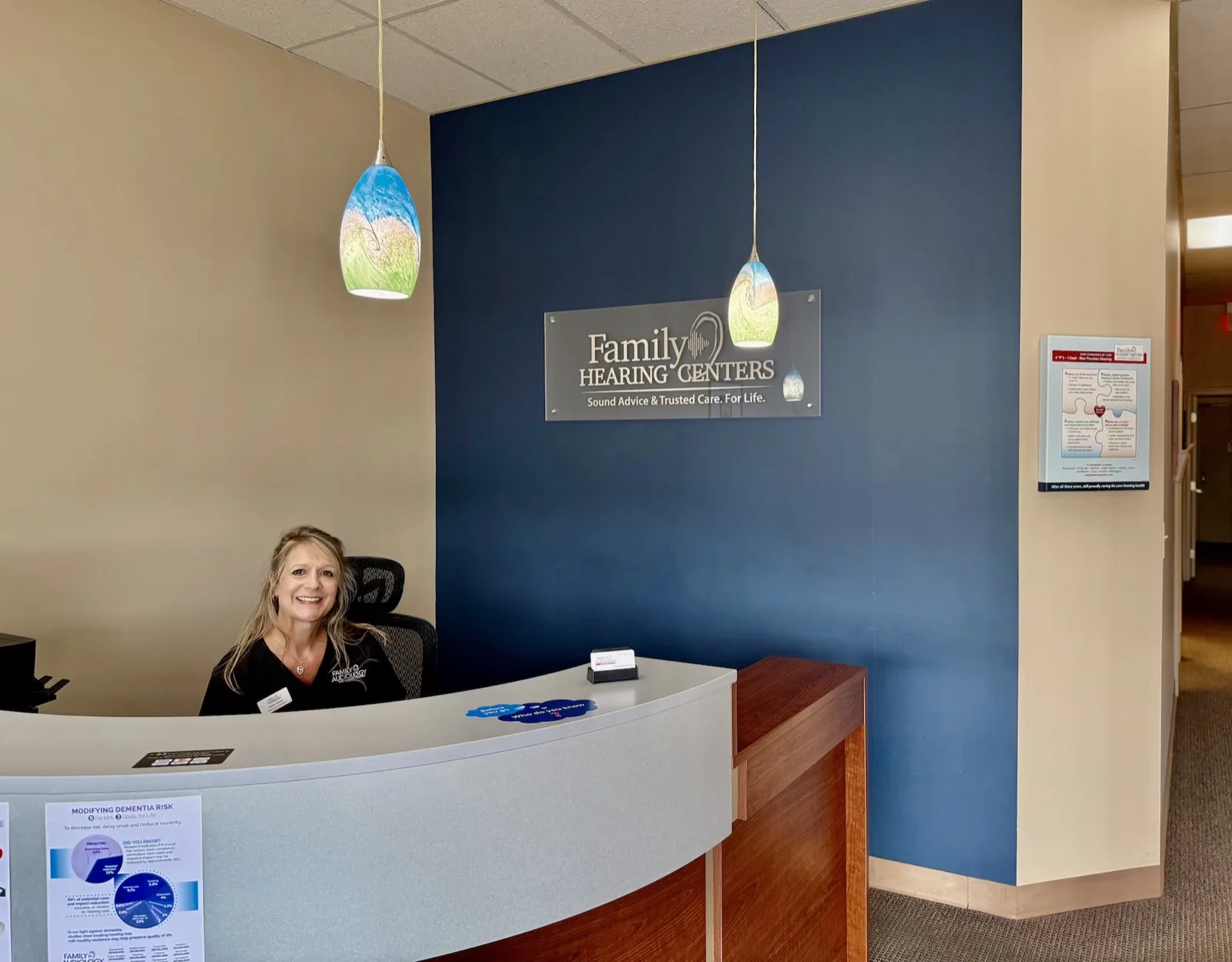
Local and family owned since 1985, with 18 convenient locations.
- No referral needed in most cases
Some insurance plans may require one for coverage, so it's worth checking with your plan.
- 18 locations close to home
16 in Ohio, 1 in Wisconsin and 1 in West Virginia.
- Family owned since 1985
3 generations of our family, and providers who live and work in your local community.
Take our 2-minute hearing check
A voice says three numbers while background noise plays. Tap the numbers you heard. The noise gets louder when you're right and quieter when you're not, so nobody gets them all.
About 2 minutes
Your answers stay on this page and are not sent anywhere.
First, set your volume
- Headphones or earbuds if you have them. Speakers work in a quiet room.
- Play the sample and turn your volume to where the voice is comfortable.
- Leave the volume alone after that.
Test version: the voice is a computer's. The finished one is a recorded person.
Listen…
Where most people with typical hearing keep up to (test version: this band is not measured yet)
This check is not a diagnosis. Phones, earbuds and rooms all differ. Only a hearing test with one of our providers measures your hearing.
Without hearing aids
More on hearing loss
4 more topics, and a service that can help.
Book a hearing test
A hearing test shows where your hearing stands today. It takes about 30 to 60 minutes, and we go through the results with you when the tests are done. In most cases no referral is needed.