Noise-induced hearing loss
Be empowered to take control of your hearing health and enjoy a safer, more fulfilling auditory experience in the years to come.
- 1 of 12 topics on hearing and your health
- No referral needed in most cases
- A hearing test takes 30 to 60 minutes
Keep safer hearing in mind
With Spring in full bloom and summer vacation season gearing up, outside activities gain popularity, including nature walks, poolside fun and strolls on the beach. When we bask in the sun’s warmth, dermatologists urgently shine light on skin cancer-related risks. Sunscreen needs to be applied, with the ideal protective SPF or sun protection factor. With 20/20 hindsight, if, in the heat of the day, prior generations were made aware, perhaps shielding from harmful rays would have been a hotter topic.
Having foresight about thoughtful protection, what do 4th of July celebrations, concerts and lawnmowing have in common? Each of these acoustic environments can be quite noisy. To keep safer hearing in mind for you and your loved ones, we proactively spread the word that Noise-Induced Hearing Loss or NIHL, is the ONLY type of hearing loss which is highly preventable.
How prevalent is NIHL?
The National Institute on Deafness and other Communication Disorders reports this startling data:
“Based on a 2011-2012 CDC (Center for Disease Control) study involving hearing tests and interviews with participants, at least 10 million adults (6 percent) in the U.S. under age 70—and perhaps as many as 40 million adults (24 percent)—have features of their hearing test that suggest hearing loss in one or both ears from exposure to loud noise. Researchers have also estimated that as many as 17 percent of teens (ages 12 to 19) have features of their hearing test suggestive of NIHL in one or both ears (Pediatrics 2011), based on data from 2005-2006.”
https://www.nidcd.nih.gov/health/noise-induced-hearing-loss
While people know what landscapes and seascapes are, have you ever heard about the term Soundscapes?
“The International Organization for Standardization (ISO) defines a soundscape as “[the] acoustic environment as perceived or experienced and/or understood by a person or people, in context. In other words, “soundscape” encompasses the way people perceive, experience and respond to the full range of sounds in a place at a given time.”1
To explain Noise Measurement, Decibels (dB) are relative loudness of sounds in the air perceived by human ears. After all, to achieve Safer Soundscapes, we must define and monitor them.
Noise-induced hearing loss may be caused by how:
- Loud noise is (dB)
- Long you hear noise (duration)
Highly respected research indicates that:
“Noise-induced hearing loss is determined by noise exposure and life-course events, all age groups can be affected. Exposure to different types of noise from early childhood might have cumulative effects on hearing impairment in adulthood.”2
As hearing care professionals intently focused on Ears Collect, Brains Connect sound processing, we also want you to recognize times when quieter environments are advantageous. Throughout medical case history discovery let’s identify noisy risks that prevail in daily activities. How loud for how long is a safe question.
To prevent Noise-Induced Hearing Loss, helpful hints include:
- Being aware which environmental noises may be hazardous, then telling family and friends
- Wearing higher quality and properly fit protective devices when participating in loud activities
- Quickly distancing yourself from loud noises which are unavoidable
With expert guidance, you will hear the facts about finding the right balance between silence being beneficial and lonely. By emphasizing noise-induced hearing loss (NIHL) prevention, we encourage you and loved ones to not wait years to protect your ears. At home, work and play, including noisy work environments or restaurants, limit exposure to loud sound levels.
Please see us for evidence-based testing, so we can accurately assess your type and degree of hearing loss. With periodic exams, we will track changes and provide trusted advice on how to be happy to hear for years to come.
How loud is too loud
Sound is measured in decibels (dB). The louder the sound and the longer you hear it, the greater the risk.3
- Normal conversation: about 60 to 70 dB. Sounds at or below 70 dB are unlikely to cause hearing loss, even over a long time.
- 85 dB and above: long or repeated exposure can cause hearing loss.
- Concerts, and earbuds at full volume: about 94 to 110 dB.
- Fireworks: about 140 to 160 dB.
For workplaces, NIOSH recommends a limit of 85 dB averaged over an 8-hour day. For every 3 dB louder, the safe time is cut in half: about 4 hours at 88 dB, 1 hour at 94 dB and 30 minutes at 97 dB.4 A simple check: if you have to raise your voice to talk with someone an arm's length away, the noise is likely loud enough to be harmful.5
When to see your doctor
See a doctor right away if you lose hearing suddenly, for example after an explosion or a very loud blast.6 Have your hearing checked if muffled hearing or ringing hasn't cleared within 2 days of loud noise.
1 https://www.unep.org/resources/frontiers-2022-noise-blazes-and-mismatches
2 Basner M, Babisch W, Davis A, Brink M, Clark C, Janssen S, Stansfeld S. Auditory and non-auditory effects of noise on health. Lancet. 2014 Apr 12;383(9925):1325-1332. doi: 10.1016/S0140-6736(13)61613-X. Epub 2013 Oct 30. PMID: 24183105; PMCID: PMC3988259.
3 NIDCD. Noise-Induced Hearing Loss. Updated April 2025. nidcd.nih.gov/health/noise-induced-hearing-loss
4 CDC, National Institute for Occupational Safety and Health (NIOSH). About Noise-Induced Hearing Loss. Updated January 2024. cdc.gov/niosh/noise/about/noise.html
5 CDC, NIOSH. Understand Noise Exposure. Updated January 2024. cdc.gov/niosh/noise/prevent/understand.html
6 NIDCD. Sudden Deafness. nidcd.nih.gov/health/sudden-deafness
Why choose Family Audiology and Hearing Centers?
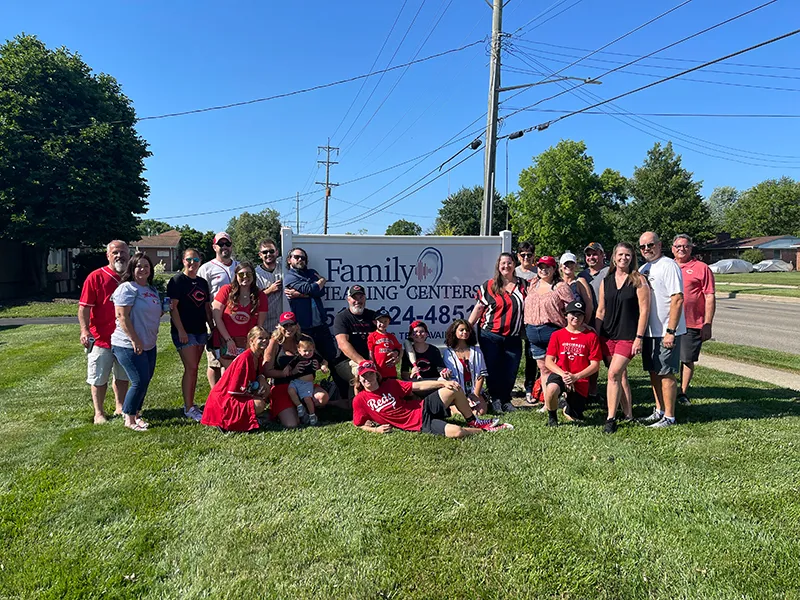
Local and family owned since 1985, with 18 convenient locations.
- No referral needed in most cases
Some insurance plans may require one for coverage, so it's worth checking with your plan.
- 18 locations close to home
16 in Ohio, 1 in Wisconsin and 1 in West Virginia.
- Family owned since 1985
3 generations of our family, and providers who live and work in your local community.
Take our 2-minute hearing check
A voice says three numbers while background noise plays. Tap the numbers you heard. The noise gets louder when you're right and quieter when you're not, so nobody gets them all.
About 2 minutes
Your answers stay on this page and are not sent anywhere.
First, set your volume
- Headphones or earbuds if you have them. Speakers work in a quiet room.
- Play the sample and turn your volume to where the voice is comfortable.
- Leave the volume alone after that.
Test version: the voice is a computer's. The finished one is a recorded person.
Listen…
Where most people with typical hearing keep up to (test version: this band is not measured yet)
This check is not a diagnosis. Phones, earbuds and rooms all differ. Only a hearing test with one of our providers measures your hearing.
Without hearing aids
More on hearing loss
4 more topics, and a service that can help.
Book a hearing test
A hearing test shows where your hearing stands today. It takes about 30 to 60 minutes, and we go through the results with you when the tests are done. In most cases no referral is needed.