
Diabetes and Hearing Loss — Why Your Audiologist Should Be Part of Your Diabetes Care Team
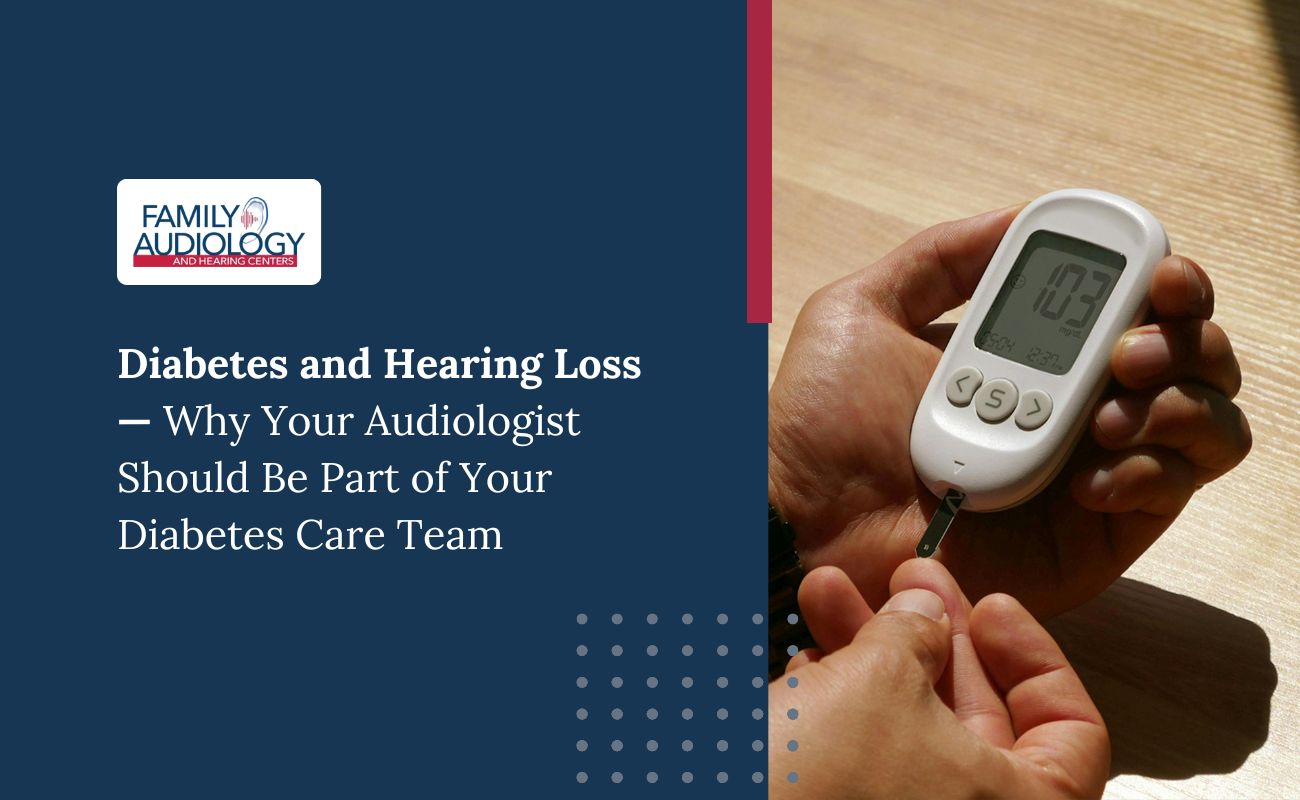


If you're managing diabetes, you've probably built a care team. This includes your primary doctor, maybe an endocrinologist, a dietitian. But there's one specialist almost no one thinks to add: an audiologist. Hearing loss and diabetes are more connected than most people realize, and that connection has real consequences for your health.
The Surprising Link Between Diabetes and Hearing Loss
Research consistently shows that people with diabetes are more than twice as likely to develop hearing loss compared to those without the condition. That holds true across all age groups and not just for older adults.
Here's why. Diabetes can damage small blood vessels throughout the body, including those inside your inner ear. Your cochlea, the part of the ear that converts sound into signals your brain can process, depends on a steady supply of oxygenated blood to function properly. When that blood flow is disrupted, the tiny hair cells inside the cochlea begin to deteriorate. Once those cells are gone, they don't regenerate.
It's a slow process, which is exactly what makes it so easy to miss.
Why Hearing Loss Goes Unnoticed for So Long
Most people don't notice gradual hearing loss until it's already moderate. You start turning up the TV a little more. You ask people to repeat themselves more often. Conversations in noisy restaurants become exhausting. It's easy to chalk all of that up to aging rather than connecting it to your diabetes.
That's why regular hearing evaluations matter. They give us a starting point or a baseline we can compare against over time. Catching changes early means more options and, typically, better outcomes. By the time most people seek help, the loss is already more significant than it had to be.
Signs Worth Paying Attention To
Hearing trouble doesn't always announce itself clearly. Watch for these signs, especially if you have diabetes:
- Struggling to follow conversations when there's background noise
- Frequently mishearing words, particularly on the phone
- Feeling mentally drained after conversations
- Asking people to repeat themselves more than you used to
- Ringing in the ears, known as tinnitus, which can be an early warning sign
Any of these is worth mentioning. We'd rather check and find everything is fine than miss a meaningful change.
How Hearing Loss Complicates Diabetes Care
This part often gets overlooked: untreated hearing loss can directly interfere with managing your diabetes. Think about how much of your care involves listening. You have conversations with your medical team, medication instructions, explanations of test results, and diabetes education programs. All of it depends on being able to hear clearly.
When hearing loss goes untreated, things slip through the cracks. You might miss part of a dosing instruction, avoid asking a question you didn't quite catch, or stop participating in group education sessions because following along has become too hard. That's not a motivation problem, but it's a communication problem with a real solution.
There's also the broader impact. Untreated hearing loss is linked to social isolation, depression, and cognitive decline. None of those make living with a chronic condition any easier.
What a Hearing Evaluation Actually Looks Like
A comprehensive hearing evaluation at Family Audiology and Hearing Centers typically takes 30 to 60 minutes. We start by reviewing your health history and asking about any symptoms you've noticed. Then we take a close look at your ears to rule out anything structural, like wax buildup, that might be affecting your hearing.
From there, you'll do a series of simple listening tests in a quiet booth. We measure how well you hear across different pitches and volumes, how clearly you understand speech, and how you perform with background noise. That last one matters most for everyday situations.
If we find hearing loss, we walk you through what the results mean and what your options are. If everything looks healthy, you leave with a baseline we'll use for comparison at your next visit. Either way, you come out knowing exactly where your hearing stands.
Adding Hearing Care to Your Diabetes Routine
Managing diabetes well means paying attention to the ways the condition affects your whole body. Hearing is one part of that picture most people don't think about until there's already a problem but you don't have to wait.
At Family Audiology and Hearing Centers, we work with patients managing a wide range of health conditions. We have several locations across Ohio and Wisconsin, and our audiologists are ready to help you get a clear sense of where your hearing is today. If you have diabetes, adding a hearing evaluation to your regular health routine is a simple step that can genuinely make a difference. Give us a call to schedule yours.


Discover the Latest Articles
Stay informed with our informative articles.

What Oticon Reveal's Dual AI System Mean for Ohio Patients

How Ohio Patients Are Using AI Hearing Aids at Work and Home
Family Audiology and Hearing Centers Is Now Open in Huntington, WV
Contact your local Hearing Aid Specialists
At Family Audiology and Hearing Centers, we strive to be there for all your family’s hearing needs. Because of this, we have 18 convenient locations in Ohio and Wisconsin for you to visit. See which location is best for you and schedule an appointment today.