
How Ohio Patients Are Using AI Hearing Aids at Work and Home
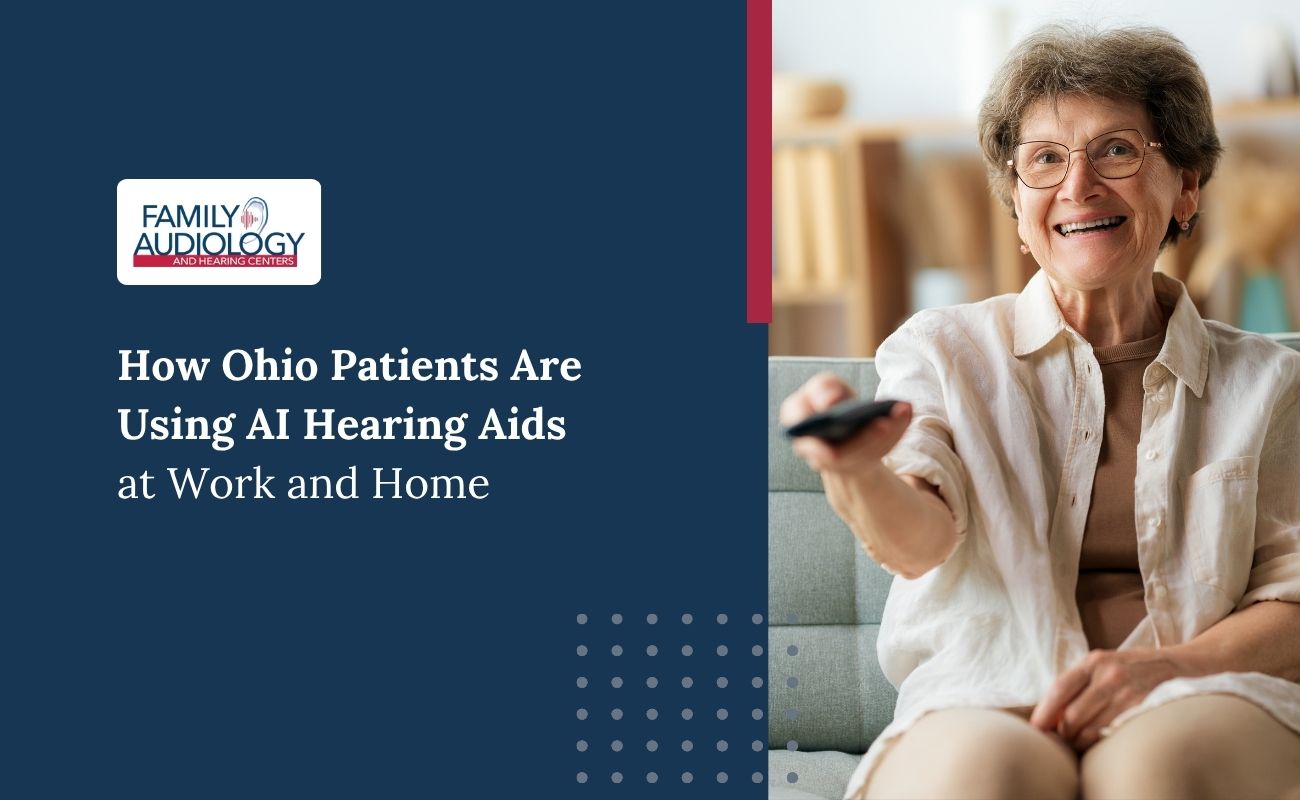


A cafeteria full of kids at lunchtime sounds nothing like a warehouse floor, and neither one sounds anything like your living room with the TV on. That's exactly the kind of shift hearing aids have had trouble handling for years. Turn the volume up enough to catch a coworker's voice over machinery, and suddenly a quiet room at home feels too loud. AI processing is finally closing that gap, and we're watching it happen with patients across Ohio.
A School Lunchroom in Dayton
One of our patients teaches at an elementary school outside Dayton. Her biggest complaint wasn't the classroom, it was the cafeteria. Dozens of kids talking, trays clattering, someone always shouting from across the room. Older hearing aids would either flood her with all of it at once or clamp down so hard she lost the ability to hear a student standing right next to her.
With newer AI-driven processing, the hearing aid is constantly reading the room, not just measuring decibels but figuring out where speech is actually coming from and what's worth prioritizing. She's not fighting the noise anymore. She's just having lunch duty like everyone else.
A Warehouse Floor in Columbus
Different environment, same underlying problem. A patient who manages inventory at a distribution center in Columbus deals with forklifts, conveyor rollers, and radio chatter most of his shift. What he needed wasn't quiet. He needed to hear a supervisor's instructions or a safety alert without missing the ambient sounds that keep him aware of what's moving around him.
That's the kind of scenario where deep neural network processing earns its keep. Instead of a single blanket setting, the hearing aid is analyzing speech, background noise, and the acoustic scene almost simultaneously, then adjusting many times a second. He describes it as the difference between wearing earplugs and just having better ears.
The Living Room Test
Here's the thing about hearing aids: they get judged the hardest at home, not out in the world. A patient in Springfield told us her real test was the couch. Her partner on one side, TV on, grandkids running through during a visit. If a hearing aid can't handle that, it doesn't matter how well it performs anywhere else.
What's changed is that these devices no longer treat streamed audio and room sound as an either-or choice. Some platforms now reduce competing room noise automatically while a call or show streams, then bring the room back once the audio stops. Small adjustment. Big difference in how natural an evening actually feels.
What's Actually Behind the Technology
None of this happens because a hearing aid got louder. It happens because the processing chips inside these devices are doing far more analysis, and doing it continuously, without waiting for the wearer to switch programs manually.
Oticon's approach layers AI systems to separate speech from environmental sound while preserving natural awareness. Phonak's newest Sphere-based platform leans on dedicated AI hardware built specifically for speech-in-noise situations. Signia has moved toward multiple task-specific neural networks working together rather than one general system trying to do everything. ReSound has built its own AI training around directional focus, aiming the device toward whoever the wearer is looking at. Starkey has pushed into generative AI tools that can troubleshoot common issues on the spot, on top of its own directional AI processing.
Different companies, different engineering choices, but the goal across the board is the same. Fewer manual adjustments. Better performance in the moments that actually matter to someone's day.
Where This Still Requires a Professional
None of this technology works well straight out of the box. It has to be fitted to your actual hearing loss, your ear anatomy, and the environments you spend time in. A warehouse worker and a retired teacher have completely different listening priorities, even with the exact same hearing aid model sitting in front of them.
OTC hearing devices can be a reasonable starting point for some people, but they're built around a general profile, not your ear or your life. Professional programming and follow-up is what turns impressive specs into something that actually works for you.
Talk to a Hearing Specialist in Ohio
Family Audiology and Hearing Centers has been helping patients across Ohio navigate exactly these kinds of real-world listening challenges, whether that's a noisy classroom, a warehouse floor, or a living room that finally feels comfortable again. We carry the latest AI-powered hearing aids from Oticon, Phonak, Signia, ReSound, and Starkey, and our audiologists take the time to figure out which technology actually fits your day, not just your audiogram.
If any of this sounds familiar, reach out to your nearest Family Audiology and Hearing Centers location to schedule a consultation. We'll help you find the right fit, wherever your day takes you.

Discover the Latest Articles
Stay informed with our informative articles.

What Oticon Reveal's Dual AI System Mean for Ohio Patients
Family Audiology and Hearing Centers Is Now Open in Huntington, WV
What Untreated Hearing Loss Does to Your Mental Health
Contact your local Hearing Aid Specialists
At Family Audiology and Hearing Centers, we strive to be there for all your family’s hearing needs. Because of this, we have 18 convenient locations in Ohio and Wisconsin for you to visit. See which location is best for you and schedule an appointment today.